AI App
 Astrology App
 Beauty Salon App
 Dating App
 E-Learning App
 Education App
 Ecommerce App
 Fintech App
 Food Delivery App
 Gaming App
 Grocery Delivery App
 Healthcare App
 Home Services App
 Hotel Booking App
 Ludo Game App
 Media Entertainment App
 OTT App
 Political App
 Pet Care App
 Real Estate App
 Taxi Booking App
 Travel App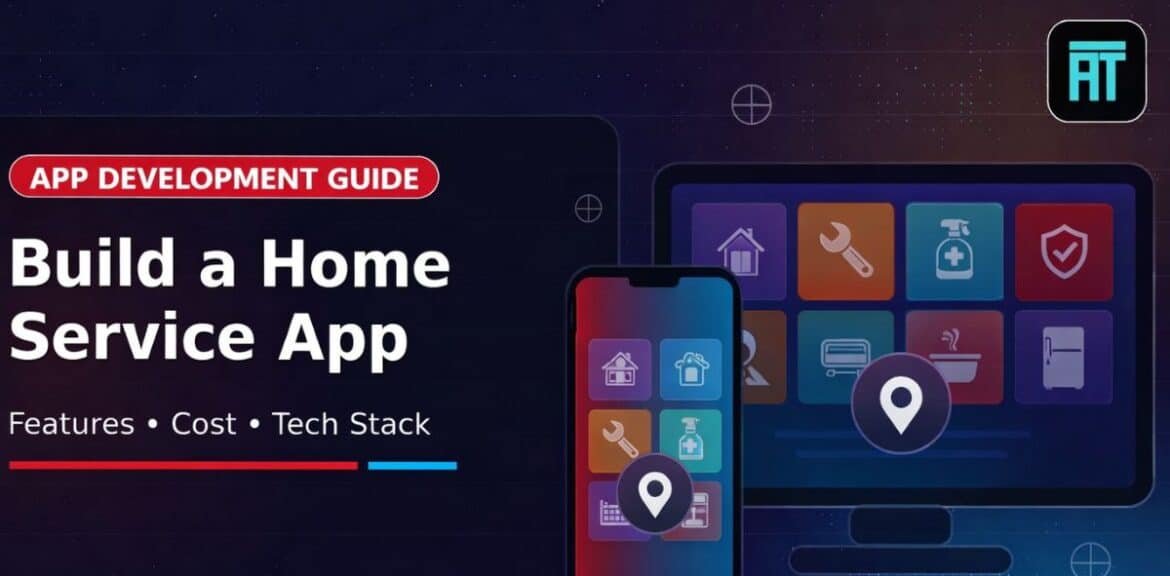

Nowadays, it’s normal for a busy home to book various home services through a mobile app. Whether it’s home cleaning, salon appointments, plumbing, electrical work, or appliance servicing, the users expect the services to be fast and reliable at their doorstep. At the same time, platforms that are modeled on Urban Company have set the bar for convenience, professional-quality, and transparent pricing, making urban app-based service bookings the go-to option.
In this article, we provide an overview of the main features, development stages, costs, and technological aspects for 2026. Astha Technologies is a reliable home service app development company, and we can guide you through the whole process of planning, developing, launching, and scaling a full home service platform anywhere in the world.
What Is a Home Service App and How Does It Work
A home service app is a digital platform that connects customers with trained professionals for various household services. These services normally range from cleaning, salon and grooming, repairs, appliance servicing, pest control, to maintenance and handyman tasks. Users no longer have to call different providers one by one, as they can find services, compare choices, and schedule appointments all from one mobile app.
The customer journey is hassle-free and straightforward. Customers just go to the app, pick a service category, select a convenient date and time and place the order after confirming the cost details. After the booking is made, the request is sent to a service professional in the vicinity, who, upon accepting the job, goes to the customer’s place, performs the service, and finally, the professional closes the task on the app.
Meanwhile, the admin panel is the core component that manages the entire system. It steers the operations concerning users, professionals, pricing, payments, and service quality. From a technical standpoint, the platform is operated by a user app, a partner app, and a centralized admin backend. Many companies join hands with a mobile app development company to create these scalable, well-integrated systems.
Why Build a Home Service App Like Urban Company in 2026
People demand convenience, safety, and time-saving, thus the need for at-home services that can be delivered at the customers’ doorsteps is increasing. Rather than making offline calls, customers are now more willing to book cleaning, salon, repairs, and appliance services through apps. Service delivery that is structured as seen in the Platforms inspired by Urban Company can effectively build trust and thus lead to the customer’s repeat usage. This change is opening up many possibilities for local and regional service marketplaces to grow steadily.
Moreover, by leveraging a home service app, a business can continuously attract customers to its services and, hence, sustain a steady inflow of revenue through repeat bookings and subscriptions. A company can initially concentrate on a few categories and gradually diversify its services over time. Through proper planning, deciding the most important features, and making the right technology choices, a company can keep the home service mobile app development cost under its control even when the platform is scalable and capable of long-term growth.
Step 1: Know the Target Users
At the heart of a successful home service app is a thorough knowledge of its users. Users vary in their expectations of aspects like speed, pricing, communication, and reliability. Once these needs have been identified at an early stage, it allows features, design, and service flow to be influenced coherently, thus cutting down misunderstandings and boosting long-term user engagement.
Customer Personas
Through their customer personas, home service platforms can realize that they are serving several groups of customers with different preferences and priorities.
- Working professionals looking for quick booking and punctual service
- Families concentrating on safety, trust, and service quality
- Elderly people who need simple screens and clear communication
- Property managers who regularly or in bulk request services
Service Partner Personas
Indeed, service professionals differ significantly in their work styles and the kind of tools they require from the app.
- Independent contractors who strive to manage flexible schedules
- Small customer service agencies that have to manage a handful of employees
- Full-time field workers who only handle the jobs assigned daily
Behavior, expectations, and pain points are key aspects that help avoid creating too many features or making the app complicated. User research, surveys, and service flow planning, which is often accompanied by consultation with a mobile app development company in Noida, play a major role in converting these insights into a good design and the right functionality.
Step 2: Choose the Right Home Service Business Model
The choice of the business model will impact how your home service app runs, grows, and makes money. Early selection of the correct model helps in aligning the service delivery, partner management, and growth over time.
- Single Vendor Model: Under this model, a single company is allowed to provide a variety of home services under one brand. It is very easy to manage and guarantees quality control, which makes it ideal for businesses that are only local.
- Aggregator Model: An aggregator platform is basically a system where multiple service providers are listed under one platform. This allows the business to expand at a faster pace and cover a wider range of services, but it does demand very good partners and quality management.
- Marketplace Model: Such a model helps customers connect with independent professionals. It allows for rapid scaling at low operational effort; however, it entails higher complexity in verification and support.
A flexible home service app development company can create platforms for all three business models. Astha Technologies can develop software for any of these business models.
Step 3: Core Features of a Home Service App Like Urban Company
A successful home service app must be a model of simplicity, reliability, and great courtesy between customers, service professionals, and administrators. Platforms inspired by Urban Company are effective because each user role receives a well-structured set of features that make the overall service flow orderly and trustworthy.
Features for Customers
- Easy registration and logging in
- Well-organized categories of services
- In-depth service pages including cost details
- Making appointments and setting schedules through time slots
- Professional available in real time
- Payments are made safely by card
- After-service, rating, and testimonials
- Past orders and fast rebooking
Features for Service Professionals
- Creation of a profile and getting it verified
- Ability to accept or decline job requests
- Viewing service scheduled for today and the week
- Navigation and customer address information
- Earnings dashboard and payment history
- Availability and working hour management
Features for Admin Panel
- Managing users and service partners
- Controlling service category and content
- Setting pricing rules, commissions
- Watching orders in real-time
- Using business analytics, performance reporting
- Dispute resolution and handling support
Step 4: UI/UX Design of Home Service Apps
The way UI and UX are designed will determine whether users can easily book and if they will come back to the app. A good home services app is one that gets rid of confusion, does not raise suspicion, and makes the entire process of booking nice and smooth for both customers and service providers.
Some of the key UI and UX principles include:
- A clean and simple interface that does not visually overwhelm users
- Easy service discovery through well-structured categories and a good search function
- Fewer steps in booking to reduce people dropping out
- Showing solutions’ prices clearly before giving confirmation
- Customer and service partner separate dashboards
- Layouts that are accessible with text size, button size, and color contrasts
This kind of human-centered design is usually achieved when there is a partnership with a mobile app development company in Delhi, India that deals in usability, accessibility, and real-life user behavior.
Step 5: Technology Stack for Home Service App Development
Your choice of technology stack influences the speed of your app, the security of user data, and the platform’s ability to scale as the number of bookings increases. Additionally, a carefully selected stack minimizes rework, decreases maintenance efforts, and contributes to optimizing the home service ppp development cost over time by maintaining consistent performance across devices and locations.
| Layer | Recommended Technologies |
| Frontend | Android: Flutter, KotliniOS: Flutter, SwiftWeb Admin: React |
| Backend | Node.js or PythonREST APIsMicroservices-based architecture |
| Database | MongoDBMySQL |
| Maps and Location | Google MapsMapbox |
| Payments | RazorpayStripePaytm |
| Notifications | Firebase Cloud MessagingOneSignal |
Astha Technologies adopts proven technologies that help the apps to stay stable even when there is a lot of usage and user data is securely kept across all the platforms.
Step 6: Build and Test the Home Service App
When planning is done, the journey of actually making the system from the ground up starts. To begin with, developers organize the backend, which is basically a part of the system that manages users, services, bookings, and payments. Then, after that core is made really steady, they bring together the customer app and the service partner app and try to see if they are working well side by side. Finally, tools for payment and features for tracking a location are increased cautiously and examined by means of real booking situations.
Testing is something that happens regularly, not only at the end. Different devices are used to run the app, slow networks are impersonated, and typical user blunders are experimented with. A professional home service app development company is one of those that uses this kind of hands-on method to provide a stable and reliable app even before the launch.
Step 7: Advanced Features of Home Service Apps in 2026
In 2026, folks expect home service apps to help them save time and effort. They don’t want to go through the same step-by-step process every time or have a hard time finding a schedule. Just a few nice features can make an app look really user-friendly and trustworthy for everyday use.
Helpful features that genuinely facilitate users’ experiences may be:
- The app recognizes the services one has previously used and, without being asked, reminds the user of them when necessary
- The prices are different by some margin during busy hours, rather than the fixed ones everywhere
- Such time slot layouts that not only save users from simple scrolling but also present a better choice for the whole day
- Reward points or very uncomplicated benefits for repeat customers
- Subscription services to simplify cleaning or the regular maintenance of appliances, etc.
- Having a very basic chat feature to reconfirm the instructions or the arrival time
- Electronic or digital bills so that users do not have to ask for paper receipts
Step 8: Launch, Promote, and Scale Your Home Service App
Launching a home service app is more than just releasing it on app stores. A well-thought-out launch strategy will bring early users, get real feedback, and get you off to a fast start. Getting feedback from end users before a full release allows the team to fix bugs, tweak performance, and polish the user-booking experience.
- Running a beta to collect user feedback and get the product ready
- Launching on App Store and Play Store with well-optimized listings
- Offering first-booking discounts to get users quickly
- Creating referral programs for organic growth
- Executing campaigns for local partners onboarding to increase service coverage
- Running social media promotions and targeted local ads
Besides being a app development company in Chennai, Astha Technologies is your go-to partner for planning your app launch and creating growth strategies for your business.
Step 9: Continuous Maintenance and Performance Updates
Once released, continuous updates ensure that a home service app remains stable and secure, and the app features evolve in line with the users’ expectations. Regular improvement not only gains the users’ trust but also encourages them to stay and facilitates the platform’s development smoothly.
- Fixing bugs and increasing efficiency
- New services and categories additions
- Workflow improvements and partner onboarding
- Customer feedback collection and analysis
- Features improvement through the study of usage patterns
- Security patches to safeguard user information
Home Service App Development Process (Step-by-Step Roadmap)
| Development Stage | Description |
| Planning and Research | Conducting a market analysis, gathering essential requirements, and defining the service flow |
| UI/UX Design | Creation of wireframes, mapping user journeys, and making visual designs |
| Frontend Development | Building a customer and partner app interface |
| Backend Development | Setting up the server, APIs, databases, and admin logic |
| Core Service Features | Booking, scheduling, pricing, and notifications |
| Partner and Admin Panels | Service professional and administrator dashboards |
| Payment Integration | Safe payment gateway and transaction management |
| Testing and QA | Testing of the functions, performance, and security |
| Deployment | App Store and Play Store publishing |
| Post-Launch Support | Maintenance, updates, and performance optimization |
Design Tools Used to Develop Home Service Apps
These are the main design tools that a home service app development company can use to produce clear, user-friendly, and scalable home service applications.
| Process | Tool |
| Wireframing / Blueprinting | Figma |
| Mockups / Prototyping | Figma |
| Screen Designing | Figma |
| Front-End Web Designing | React JS |
| Color Schemes / Fonts | Coolors |
Backend for Home Service App Development
| Backend Component | Tools |
| Programming Language | Node.js, Python |
| Database | MongoDB, MySQL |
| Cloud Services | AWS, Google Cloud |
| CI/CD | Jenkins |
| Load Balancer | NGINX |
| Server Environment | Linux, Ubuntu, Windows |
Cost of Developing a Home Service App like Urban Company
| App Complexity Tier | Estimated Cost Range | Approx. Timeline |
| Basic Home Service App | 4 Lakh – 6 Lakh | 3–6 months |
| Mid-Level Home Service App | 7 Lakh – 11 Lakh | 6–9 months |
| Advanced Urban Company–Like App | 15 Lakh – 25 Lakh | 12–18 months |
Why Choose Astha Technologies for Home Service App Development
Astha Technologies covers the whole range of development support for home service platforms, starting from planning, design, development, extending to testing, and final deployment. The team aids businesses in releasing their platforms to the market by means of cost-effective planning and a sharp focus on the scalable architecture, thus helping to create dependable and growth-ready platforms.
Astha Technologies, a reputable name in home service app development, leans towards minimalist and clean UI design and highly reliable customer care support after the launch. This strategy aims to achieve frictionless operations, increased user satisfaction, and platform stability over time.
Conclusion
By partnering with a mobile app development company in Agra, India, businesses can easily enter the rapidly growing home service platform market. Relying on apps for household chores is a trend, and the success of any app providing such services will be the result of meticulous planning, an appropriate feature set, and a scalable technical foundation. Developing a user-friendly and dependable app will be a tool for gaining the trust of customers and will, therefore, sustain long-term growth not only in terms of services but also in locations. Teaming up with a proper execution partner, companies can avoid the most common mistakes and focus their energies on continuous value delivery. Astha Technologies is a great choice if you want to be backed by the expert knowledge needed for building, launching, and scaling a home service app without worry.
Ready to Build a Custom AI-Powered App?
12M+
App Downloads
6 Months
Free App Maintance
20+
Industries Served
3 Months
Free Maintenance
×