AI App
 Astrology App
 Beauty Salon App
 Dating App
 E-Learning App
 Education App
 Ecommerce App
 Fintech App
 Food Delivery App
 Gaming App
 Grocery Delivery App
 Healthcare App
 Home Services App
 Hotel Booking App
 Ludo Game App
 Media Entertainment App
 OTT App
 Political App
 Pet Care App
 Real Estate App
 Taxi Booking App
 Travel App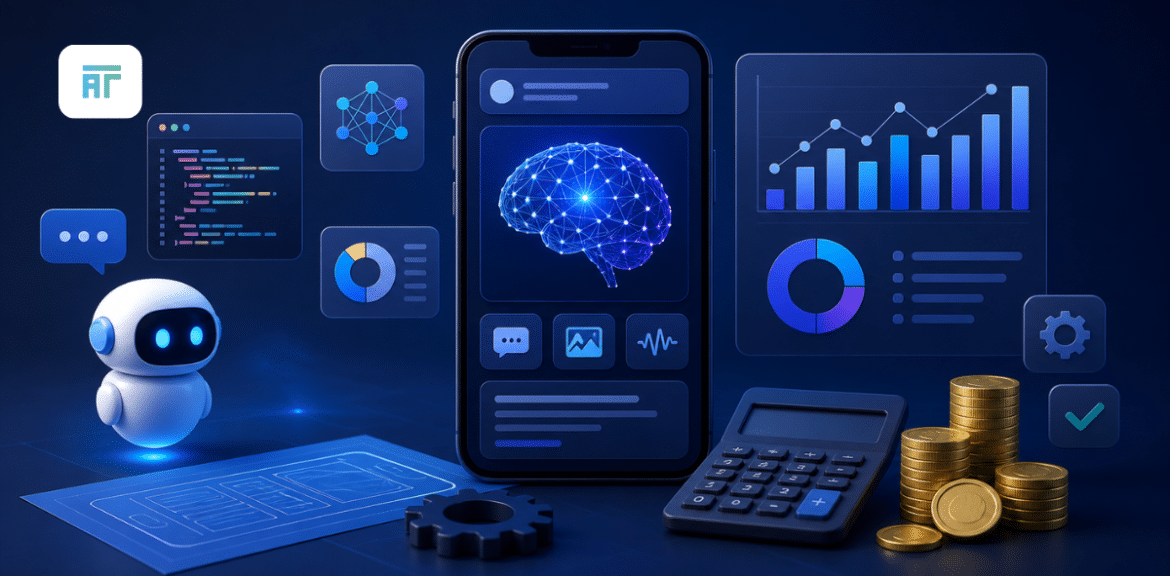

Artificial intelligence is currently featured in many everyday digital products, influencing how platforms interact with users across health care, finance, e-commerce, and education. Companies are employing AI to automate previously manual tasks, thereby making systems more responsive and efficient. Customers want smart automation, individualized services, and quicker decision-making without any inconvenience or perplexity. An expert AI app development company will focus on designing apps that not only deliver the right results but also keep the interface simple so they can be used regularly by different kinds of users.
More and more AI software is being implemented to enhance business efficiency, reduce staff workload, and help make better decisions that give the business an advantage. The cost of developing an AI app usually ranges from ₹6,00,000 to ₹ 15,00,000+, depending on the complexity of the features, the quantity and quality of the data, and the size of the system. Astha Technologies builds AI programs in a very hands-on way so that the product can offer a high level of reliability and is able to meet an increasing number of users.
What Makes an AI App Successful?
One of the major reasons an AI app succeeds is when users don’t sense its complexity. The simple, clear interface should be the only thing users see and work with, even when the system is processing sizable amounts of data in the background. It is still necessary that results be accurate, whether the app is giving recommendations or making predictions, because if the output is inconsistent, trust will be lost very quickly. Besides, response time is important, since any delay will ruin the experience during real-time use. Hence, a trusted Mobile app development company in Noida prioritizes both stable performance and strict data security and privacy at every moment of interaction.
The major part of the burden lies on the system behind the app. AI models based on machine learning, natural language processing, or computer vision represent the main logic part, whereas data pipelines show how information moves in and out. Besides, API integrations link the app with external tools, and personalization engines change results depending on user behavior over time. Continuous learning is what makes the system relevant; still, none of these will be possible without a scalable structure to accommodate increased usage.
Key Factors Influencing AI App Development Cost
The AI app development cost varies significantly depending on feature complexity, data volume requirements, platform selection, and the system’s design and scalability.
1. App Complexity & AI Features
The complexity of an application has a direct impact on the price of AI for app development. Very simple features, such as rule-based chatbots or simple recommendations, take less time and effort, whereas human-like conversational systems and predictive models will require more development work in general. The most complex features, like deep learning, computer vision, and real-time data processing, will require not only more data and infrastructure but also more expertise. Hence, the overall cost rises significantly with complexity.
2. Type of AI Application
The kind of project you decide to develop will greatly affect the amount of work and money needed. A straightforward chatbot or recommendation system can be made quickly since there is not enough flow. SaaS AI products or automation tools require more user handling and system connections. The building of apps for a particular industry is much more detailed, and the work goes up even more after understanding the domain, creating logic, and having nicer data, which are the parts that altogether push the price higher.
3. UI/UX Design
In AI applications, designing is not about the art of the looks but about the logic behind interpreting complicated results. It must be so straightforward that through neat dashboards, simple visualizations, and user-friendly flows, users can understand the outcomes easily without having to wonder if they are right or not. Templates are mostly good for layouts that require less time, but they usually also feel quite limiting when the number of features increases. On the other hand, custom design requires dragging the users around to see how they can use the AI responses, hence it is more time-consuming. A practical Mobile app development company in Delhi NCR plans this carefully, as better clarity often means higher design time and cost.
4. Platform Selection (Android, iOS, Web)
The platform you select will have a direct impact on resource planning for AI app development services. Numerous teams initiate the project with Android as it gives them a leash on their early spending and also facilitates quick market testing. After the product gets recognized, the move to iOS or other platforms becomes a reasonable step. Cross-platform frameworks help minimize effort, but they also require attention as AI features increase. Usually, a web dashboard is developed in parallel with the app in order to administer users, oversee data, and analyze performance without burdening the mobile interface.
- Adopting an Android-first strategy lowers the initial development expenditure.
- Cross-platform development tools help reduce the amount of duplicate work done across platforms.
- Web dashboards ease the administrative control and analytics management.
5. Backend Development & Infrastructure
Backend development is the major contributor to AI applications, because all activities, such as data processing, model deployment, and live responses, happen through the backend. An efficient generative AI app development company builds systems that support uninterrupted data flow, seamless integration of APIs, and maintenance of stable performance when large-scale user interactions with AI features occur.
- Data storage must not become a bottleneck, even with the addition of large and growing datasets.
- Model serving guarantees fast and regular delivery of AI outputs.
- System scalability offers users an increase in workload support.
- Performance optimization ensures real-time computation is smooth and dependable.
6. Third-Party Integrations
It is a common practice among AI apps to leverage third-party tools for performing fundamental operations that cannot be done completely in-house. The central capabilities remain powered by the likes of OpenAI, Google AI, or AWS AI, whereas handling payment and user notification is done through the respective gate/payment systems. Business functionalities can be connected to the app through CRM or ERP integrations. As a Mobile app development company in Agra, Astha Technologies not only executes these integrations but also carefully schedules them, since overreliance on third-party services restricts the flexibility, increases the continuing costs, and even jeopardizes the whole system stability if not handled properly.
7. Data Requirements & Processing
Working with data generally requires more time and effort than most people anticipate in an AI application. Firstly, data needs to be gathered from various sources. Then, it should be thoroughly cleaned and finally, organized into training sets that the system can utilize effectively.
Having a bigger volume of data usually leads to better results; however, it also contributes to additional storage and processing requirements. Low-quality data results in the generation of irregular outputs, which in turn necessitate continual corrections and thus prolong the project time, ultimately escalating the total development costs.
8. Compliance & Security
The security aspect of using AI applications that continuously serve user data is gradually becoming a focal point of concern. Data protection laws are quite explicit about the manner in which information should be stored and used, thereby resulting in the addition of further steps to the development process. Encryption is mandated to ensure the safety of the data during its transmission, whereas secure storage safeguards the data for a longer period. A reputable Mobile app development company in Hyderabad embarks on security and compliance measures quite early since a breach in these aspects can lead to grave consequences when it comes to handling sensitive data.
9. Technology Stack
The technology choices determine the app’s performance, scalability, and AI capacity. Besides, the stack should enable easy development, data processing efficiency, and consistent performance as the user base expands over time.
| Area | Tools |
| Frontend | Flutter / React Native |
| Backend | Node.js / Python |
| AI/ML | TensorFlow / PyTorch |
| Database | MongoDB / PostgreSQL |
| Cloud | AWS / Google Cloud |
10. Development Team & Location
The choice of the appropriate team significantly determines the advancement of the project and its cost in the end. Partnering with an AI app development company might be cheaper if the team’s pricing method and technical skill level make it so.
The number of members in a team influences both the pace and the price. A small team is likely to require more time but will help keep the budget low, whereas a large team can work faster but comes with a higher cost. Apart from that, the level of experience is very important because expert developers will need less redoing, and they will know how to build more successful AI systems from the very beginning.
11. Advanced AI Features
Personalization engines, real-time analytics, voice recognition, computer vision, and multi-language support are just some of the advanced AI features that could potentially increase not only the depth of an AI application but also the effort and cost. Usually, these features are added in different phases rather than building everything at the same time. Core functionality is what one starts with, and this helps keep the system stable. Later updates based on user needs can then introduce more advanced capabilities. Such a style of development is not only more manageable but also reduces the unnecessary complexity in the early stages.
Estimated Cost Breakdown to Develop an AI App
TheAI app development cost covers one entire process from planning, designing, developing, to testing. Each step affects the cost to a different degree depending on the complexity of the features, the technical requirements, and the size of the project as a whole.
| Development Stage | Estimated Cost |
| Planning & Research | ₹75,000 – ₹2,00,000 |
| UI/UX Design | ₹1,50,000 – ₹3,00,000 |
| Frontend Development | ₹2,00,000 – ₹4,00,000 |
| Backend Development | ₹2,00,000 – ₹5,00,000 |
| AI Integration | ₹1,00,000 – ₹3,00,000 |
| Testing & QA | ₹75,000 – ₹1,50,000 |
| Deployment | ₹50,000 – ₹1,00,000 |
| Total Cost | ₹6,00,000 – ₹15,00,000+ |
Cost Based on App Scope
With changes in scope, the cost of AI app development will also fluctuate, mainly because simpler apps require fewer resources. On the other hand, advanced systems will not only incur higher development costs but also require deeper integration of AI and a more robust infrastructure to support their complex features.
| Version Type | Features | Cost Range |
| Basic MVP | Simple AI features, chatbot, or recommendation | ₹6,00,000 – ₹8,00,000 |
| Standard App | NLP, dashboards, integrations | ₹8,00,000 – ₹12,00,000 |
| Advanced App | Deep learning, automation, analytics | ₹12,00,000 – ₹15,00,000+ |
Post-Launch, Hidden & Ongoing Costs
The costs do not end after launch for AI app development services, as the system requires ongoing monitoring to ensure it continues to function properly. Depending on the usage, the cost of cloud hosting can be anywhere from ₹10,000 to ₹60,000 per month. Without retraining the AI models as new data becomes available, the outputs start to differ significantly. With more activities, API usage increases, which also contributes to the total cost over time. While regular maintenance needs only gradual updates, feature introductions require more work. To produce reliable results, an AI system must be continually adjusted, which leads to increased expenditure over time.
Monetization Strategies for AI Apps
Revenue from AI for app development is generated primarily through a combination of pricing models. This is because users will experience ways of interacting with features that differ from their spending patterns as usage grows.
- Subscription model: This is a monthly payment method that the user signs up for in exchange for using the app for as long as they wish, without interruptions.
- Usage-based pricing: Users are charged more as they use the product for longer or make more app requests.
- SaaS licensing: This is the best pricing model when the product is being used by different teams within the same company.
- Ads (limited): In-app advertisements are one of the many revenue streams, but the ads are so minimal that they hardly affect the feel of the application.
- Premium AI features: Advanced functionalities offered to users for an additional charge.
How Long Does It Take to Develop an AI App?
The time frame for a project depends entirely on how much is being built and how complicated the system turns out to be. Astha Technologies intends to map out the development process phase by phase and organize work so that delays can be avoided in the future.
| Complexity | Timeline |
| Basic | 2–3 months |
| Standard | 3–5 months |
| Advanced | 5–8 months |
Essential Panels & Core Feature Architecture
A well-defined structure is necessary to prevent various components of the app from overlapping as it expands. A dedicated generative AI app development company will segregate the panels in such a way that each feature operates independently and without any mix-up.
User Panel
This is the point at which the users get engaged with the app. They can provide inputs and see what is produced by the AI. Keeping the flow simple is necessary so that using the features does not cause confusion for users.
Admin Panel
The admin panel provides tools for user management, activity tracking, and overall performance monitoring. It facilitates governing operations without overtly changing the AI system’s mode of functioning.
AI Engine Panel
This is the background worker that keeps on running the model, implementing the training, and making the outputs better. It will definitely help retain the desired quality of results as the data changes and the use of the system grows.
How to Reduce AI App Development Cost
Aside from the fact that making a whole product idea in the first version is certainly a recipe for failure in terms of time and effort, it is still far better and safer to start with a minimum viable product, check how the app works, and only decide what really needs to be added. Instead of developing a model from scratch, a significant time can be saved by making use of ready-made models. When the focus is laid on one platform at a time, both development and management tasks get easier.
When designing software, Astha Technologies first stabilizes the fundamentals and only then adds new features. Additionally, sharing common and repetitive tasks across existing codes and avoiding rewriting functions using existing APIs can minimize extra work. Getting user feedback as soon as possible also greatly helps steer the development to the next phase of features, thereby saving money on features that may never be used.
Is Building an AI App a Profitable Thing to Do?
The necessity and demand for AI applications across various industries have made them an excellent investment avenue. Automation not only helps reduce manual effort but also continuously reduces operational costs. These systems, once developed, have the potential to scale up without the need for a proportional increase in resources. Returns on investment in the long run vary with the frequency and consistency of the usage; however, excellent scalability along with the continuous demand can render AI applications a profitable and feasible option for a large number of enterprises.
Why Choose Astha Technologies for AI App Development
Astha Technologies primarily aims to develop AI systems that can efficiently handle increased user volume without complicating other parts of the system. The method saves time and money on development by first identifying and implementing key features, then gradually adding more features. There is a strong focus on security to ensure data is always kept safe. To keep the development process transparent and clear, each project is carried out in several stages, which, in turn, guarantee a reliable final product free of unnecessary complexity.
Conclusion
Typically, the AI app development cost ranges from ₹6,00,000 to ₹15,00,000+. The deciding factors are mainly the feature complexity, data volume, and the level of scalability required for the system. MVP development is the best strategy to keep spending in check, and it also gives you an opportunity to see the app working in real conditions. Output accuracy largely depends on data quality, while scalability is about ensuring the app can handle increased user load without breaking down. Also, performance should be consistent so that the experience is not disrupted by rising demand.
Astha Technologies takes a very structured approach, building step by step rather than overloading features from the very beginning. It keeps development realistic, well under control, and in line with long-term growth, without the pressure of extra costs that are actually quite high.
Ready to Build a Custom AI-Powered App?

12M+
App Downloads
6 Months
Free App Maintance
20+
Industries Served
3 Months
Free Maintenance
×