AI App
 Astrology App
 Beauty Salon App
 Dating App
 E-Learning App
 Education App
 Ecommerce App
 Fintech App
 Food Delivery App
 Gaming App
 Grocery Delivery App
 Healthcare App
 Home Services App
 Hotel Booking App
 Ludo Game App
 Media Entertainment App
 OTT App
 Political App
 Pet Care App
 Real Estate App
 Taxi Booking App
 Travel App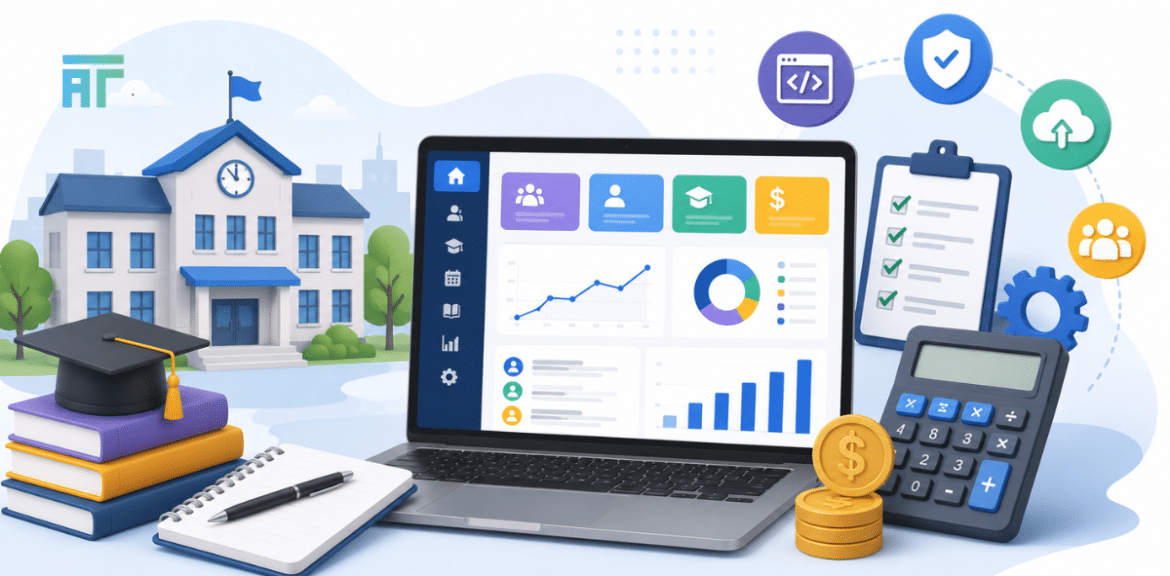

Institutions of education throughout the country are increasingly turning to computerized methods to organize school administration and improve overall efficiency. Schools, on the other hand, are investing in school management software to handle admissions and attendance, fee collection, examinations, communication with parents, and reporting, not only to reduce manual work but also to streamline daily processes. The increasing demand for centralized data management and automation has made these systems an indispensable feature of modern educational institutions.
Development expenditures generally depend on the school’s range, the required modules, the type of integration, deployment preferences, and customization needs, and thus may vary from $2100 to $19,000 or more. Whereas ready-made solutions promise speedy implementation, in-house-developed platforms allow greater freedom and the ability to scale up in the long term. Astha Technologies offers assistance in creating customized solutions for schools, coaching institutes, and educational groups, ensuring the best school management software experience aligned with their distinct operational needs.
Why School Management Software Is Becoming a Need for Schools
With the rise in student admissions, schools are being burdened with administrative tasks that cannot be handled by manual methods alone. There is a growing demand for consolidated data handling, effective communication with parents, access through mobile devices, support for online education, and accurate reporting to education authorities, which has led to the widespread use of school management system software. Besides, schools achieve more through efficient handling of admissions, attendance, fee collection, examinations, and record-keeping. If a reliable mobile app development company in Delhi, NCR is engaged, educational institutions can have customized solutions that meet their changing academic and operational needs while improving the overall experience for administrators, teachers, parents, and students.
What makes school management software stand out?
A successful school management system is one that is very easy to use and highly automated, ensuring that information is available to teachers, administrators, students, and parents without any hassle. Robust data protection, role-based access, mobile-friendliness, cloud integration, and the ability to manage multiple campuses are just some of the features that contribute to the software’s long-term success. As schools continue to digitize their operations, many are opting for online school management software that can be upgraded to meet changing needs. Astha Technologies is a developer of products that strike a proper balance among ease of use, safety, and operational efficiency while catering to the changing requirements of educational institutions.
Types of School Management Software
Academic and non-academic activities of institutions are managed by different software modules. Each software is equipped with exclusive features that help institutions collect data, eliminate manual operations, and operate efficiently.
Student Management System
Records student profiles, admission records, academic history, contact details, and enrollment information. The software enables schools to keep systematic records and get access to crucial student information at any time.
Fee Management Software
Automate the tedious process of fee collections. It also helps a school keep track of finances, monitor the payments of the students concerned, generate receipts at the time of payment, identify outstanding dues, and maintain the school’s financial records through a single system.
Attendance Management System
It is a boon to teachers as recording attendance becomes very handy with this system. Also, it aids school heads in getting a comprehensive overview of various attendance trends. Schools can access records easily whenever reports or reviews are required.
Exam & Result Management
Exam & Result Management enables you to handle examination-related activities efficiently by controlling the exam calendar, scores, report cards, result publication, etc. One can have well-organized academic records, which will help in a quick review of student performance and progress over a period of time.
Teacher/Staff Management
Collection of personnel data, branch information, time and attendance records, and work assignments at a single location. School administrators can carry out staff management-related activities without handling separate files.
Timetable Management
It provides the necessary support for preparing classes, subjects, and teacher allocations for the entire academic year. Besides this, it enables schools to coordinate schedules and minimize period conflicts.
Homework & Assignment Management
This feature makes it very easy for a teacher to set and share homework or assignments along with instructions. Students no longer need to rely entirely on verbal classroom communication, as all homework-related information is readily accessible to them, including the tasks to be done, submission criteria, and deadlines.
Key Factors Affecting School Management Software Development Cost
The best school management software fundamentally depends on factors like the size of the institution, different workflows in place, how complicated the operations are, and, what’s more, the growth plans of the institution.
1. School Size and Operational Complexity
Small schools with just a few hundred students operate quite differently from those that operate on several campuses. A primary task of smaller schools tends to revolve around admissions, attendance, fee collection, and daily record-keeping, which makes their development needs fairly simple. However, with the increase in the student population, schools have to introduce different sets of functions for academics, transport, examinations, staff management, and reporting. Besides, the educational groups that also manage multiple branches might be inclined to have centralized control, branch-level access, and consolidated data. Since each additional process will require more development and testing, the size of the institution will directly affect the overall school management software cost .
2. Features and Modules Included
The number of modules present in a software platform is one of the major factors determining the cost of school management software. A very simple one may only address student records, admissions, attendance, fees, examinations, and timetables, whereas features grouping transport management, library tracking, hostel administration, HR, payroll, parent portals, analytics, and mobile applications are generally required by large institutions. Each module means new workflows, permissions, testing, and integration work.
A reliable mobile app development company in Chennai will first understand the school’s operational requirements and then, with some discussion, prioritize the modules by time and necessity so that the development budget stays well within the present requirements and the expansion plans of the future.
3. Cloud-Based vs Web-Based vs On-Premise Deployment
Schools appreciate cloud-based solutions because they require almost no hardware and can be accessed from anywhere in the world. Besides this, schools can easily scale storage, users, and features as their needs change, and therefore, cloud deployment is a very economical solution for many institutions.
Web-based software, on the other hand, runs in a browser, making it very easy to maintain, update, and grant access to different departments. Since there is no need to install software on every device, schools can also reduce administrative overhead while keeping things running smoothly.
Deploying on-premises gives schools the most control over infrastructure and data management, but it usually requires dedicated servers, IT support, and a larger initial investment. So, one’s preferences in deployment will also matter a lot in the final school management software cost.
4. UI/UX Design Requirements
Without a doubt, even software that is packed with features can be counterproductive if users cannot figure out how to use it. It’s not just that school staff may be pressed for time; parents and students also want instant access to information via their mobile phones. Thus, schools are turning to solutions with intuitive dashboards, easy navigation, separate parent portals, teacher workspaces, and student self-service features that require little training. Besides, mobile-friendly layouts, custom workflows, and role-specific screens mean more design and testing work during development. A reliable mobile app development company in Noida typically takes these aspects into account while planning the user journeys, which may raise the overall project cost but significantly enhances the daily usability.
5. Mobile Application Development
Today, a school management system can’t be confined just to office computers. Parents, for one, would love to get instant updates on attendance, fees, exam results, and school notices without having to call the school office. On the other hand, teachers will probably be uploading homework, sharing class updates, or recording attendance while moving to different classes. Besides, students will be looking forward to getting assignments and schedules quickly on their phones. Since the parent, teacher, and student apps will have additional screens, permissions, testing, and ongoing updates, this will make developing software for school management significantly more expensive.
6. Fee Management and Payment Gateway Integration
Among the functions in the school management system, fee collection is widely used; therefore, most institutions adopt automated payment processes. Besides allowing online fee payments, schools also need features that provide instant receipt generation, automated reminders for pending dues, and support for multiple payment methods, such as UPI, cards, net banking, and wallets. To make these services operate perfectly, it is necessary to integrate them with external payment providers, and this requires additional security measures. Astha Technologies can help schools introduce these features and functionalities, but note that integration, testing, compliance requirements, and transaction workflows can significantly increase the overall development budget.
7. Online Examination and Result Management
Nowadays, a good number of schools are taking assessments online as the quickest way to both administer exams and better track student academic progress. While digital features like online testing, instant auto-evaluation, and generating report cards based on performance may give the illusion of being a mere data-entry operation, a lot more goes into it. The system should be capable of managing question banks, various grading schemes, student handwriting recognition, result computations, and keeping voluminous academic data with high accuracy. These areas, being the source of different workflows, permissions, and reporting requirements, are usually quite heavy in development and testing, thus greatly impacting overall school management software cost.
8. Third-Party Integrations
It is rare for schools to operate with just one software system. Most schools link their software to an SMS gateway for sending alert messages, WhatsApp for parent communication, a payment gateway for fee collection, Zoom or Google Meet for online classes, biometric devices for attendance, RFID systems for student tracking, GPS-enabled transport monitoring, etc.
Although these integrations enhance comfort and reduce manual work, any new link will require additional programming, setup, security, and testing. Astha Technologies helps schools carry out such integrations effectively; however, the greater the number and complexity of external systems, the greater the effect on final development costs.
9. Security and Compliance Requirements
Schools keep lots of different data besides just academic records. Admission applications, billing details, parents’ contact information, exams, staff information, and even internal communications are usually part of the same system. Even one wrong move can lead to the exposure of private information or affect the entire operation of the school. This is why more and more schools are turning to solutions like the best school management software, which offer user access control, data encryption, regular backups, and activity logs. Also, different roles require different access permissions, from school managers and instructors to finance personnel and parents, thereby making security management a bit more complicated. Implementing these protections requires additional development effort and directly impacts the overall project cost.
10. Technology Stack Selection
The technologies selected for building a school management ERP software at development time not only decide the level of performance but also the flexibility and long-term dependability of the software. A good technology stack choice enables schools to provide for their future growth, the incorporation of more modules, handling of a larger number of users, as well as their regular maintenance without the need for system changes often.
| Area | Common Technologies |
| Frontend | React.js, Angular |
| Backend | Node.js, Laravel, .NET |
| Database | MySQL, PostgreSQL, MongoDB |
| Cloud Infrastructure | AWS, Azure, Google Cloud |
| Mobile Development | Flutter, React Native |
| APIs | REST APIs, GraphQL |
| Security | OAuth, JWT, SSL |
| Analytics | Power BI, Custom Dashboards |
11. Development Team and Location
The ones developing the software may have an impact on cost and the final outcomes that are realized for a long time. It is possible that freelancers are suitable for quickly closing small requirements, whereas agencies usually have more capabilities in terms of technical support and project management. Those with a background in education technology are probably quite familiar with the processes of a school, which could result in fewer delays and waste of time for revising. Geographical location is another factor that could determine price levels since development fees tend to differ not only between cities but also between regions and service providers.
Estimated School Management Software Development Cost Breakdown
The cost of school management software is typically spread over several software development phases, starting from planning and designing to testing, deployment, and system integration.
| Development Stage | Estimated Cost |
| Requirement Analysis | $425 – $1,270 |
| UI/UX Design | $530 – $2,115 |
| Frontend Development | $795 – $3,170 |
| Backend Development | $1,060 – $5,285 |
| Database Development | $425 – $1,585 |
| Integrations | $320 – $2,640 |
| Security Implementation | $320 – $1,585 |
| Testing & QA | $425 – $2,115 |
| Deployment | $210 – $795 |
| Total Development Cost | $2,100 – $19,000+ |
Cost Based on School Management Software Scope
The range of features of an online school management software solution affects the development cost directly. Schools that only have basic administrative needs generally choose to have fewer modules, while big schools may go for a highly automated system, mobile access, analytics, and multi-branch management features.
| Software Scope | Key Features | Estimated Cost |
| Basic School Management Software | Admissions, attendance, fee management, and student records | $2,100 – $5,300 |
| Standard School Management ERP Software | Exams, library, transport, communication, reporting | $5,300 – $10,600 |
| Advanced School Management ERP Software | Mobile apps, HR, payroll, analytics, and online exams | $10,600 – $14,800 |
| Enterprise Multi-School ERP | Multi-branch management, custom workflows, and advanced integrations | $14,800 – $19,000+ |
School Management Software Cost by Institution Type
As student numbers, staff strength, and administrative responsibilities increase, the requirements of a school typically change. Bigger schools, in most cases, would have to cater to a vast range of activities, thereby adding development complexity and increasing project cost.
| Institution Type | Estimated Cost |
| Small School (Up to 500 Students) | $2,100 – $5,300 |
| Medium School (500–1500 Students) | $5,300 – $10,600 |
| Large School (1500+ Students) | $10,600 – $14,800 |
| School Group / Education Chain | $14,800 – $19,000+ |
Advanced School Management ERP Software Features That Increase Cost
Quite a few schools, at one point or another, go beyond simple administration and adopt advanced software for school management. For instance, AI-driven analytics, student performance prediction, LMS integration, online tests, video lessons, GPS-based transport tracking, multi-branch management, and tailor-made approval workflows take a lot more planning and development time. Besides, such features need high data processing, live updates, third-party integrations, and complex user permissions. As a result, teams will need to spend more time on system design, testing, and fine-tuning. So, that will lead to a considerable increase in the overall cost of the project.
Hidden Costs Most Schools Overlook
Developing software is only a fraction of what a school system spends overall. Often, schools are surprised by extra costs for cloud hosting, tech support, data migration, staff training, messaging services, payment processing, security reviews, mobile app updates, and adding new features down the road.
Besides that, when the school population increases or new campuses are opened, operational expenses may rise even more. At Astha Technologies, we believe that schools should consider these continuous needs while planning so that they will have fewer unexpected expenditures once the system is up and running.
Build vs Buy: Which Is Better for Schools?
Schools that are considering a school management system software usually have to decide whether to buy an off-the-shelf product or develop a product themselves. Each option has its own pluses and minuses regarding price, flexibility, control, ability to grow, and support over the long-term operations.
| Factor | Ready-Made Software | Custom Development |
| Initial Cost | Lower | Higher |
| Deployment Speed | Faster | Longer |
| Customization | Limited | Extensive |
| Scalability | Vendor Dependent | Fully Flexible |
| Integrations | Moderate | High |
| Ownership | Vendor Controlled | Full Ownership |
| Best For | Small Schools | Growing Institutions |
Essential Modules Every School Should Prioritize First
The best school management software is usually a result of a gradual process of development. A lot of schools begin by using core modules that help them to handle simple administrative tasks on a daily basis before they get more advanced features.
- Student Information Management
- Admission Management
- Attendance Management
- Fee Management
- Examination Management
- Communication Module
- Reporting Dashboard
How Long Does It Take to Develop School Management Software?
Development time varies based on features, customization, integrations, and complexity.
| Complexity | Timeline |
| Basic Software | 2–3 Months |
| Standard ERP | 3–5 Months |
| Advanced ERP | 5–8 Months |
| Enterprise Solution | 8–10+ Months |
How to Reduce School Management Software Development Cost
A great way for schools to keep development costs under control is to concentrate on building co-resetting modules to be fully functional day one. By introducing the system gradually, selecting a facility architecture, using advanced technologies, and leveraging well-established third-party services, it will be possible to manage costs effectively. Not doing too much customization in the first phase and deciding how to develop the product further from the beginning will save the company from costly changes later.
Is Developing School Management Software Worth the Investment?
For most schools, the benefit is much more than just automation. An efficiently designed system has the potential not only to ease daily administrative tasks but also to accurately track fees, enhance parent-teacher communication, and keep student records well organized. Eventually, better-managed processes, faster access to information, and enhanced decision-making can help achieve the school’s overall objectives more substantially and efficiently.
Why Choose Astha Technologies for School Management Software Development
Astha Technologies assists schools and other educational bodies in creating software systems that suit their teaching and learning, as well as their administrative processes, rather than trying to fit them into ready-made systems. The company’s expertise in custom ERP development, student data security, mobile and web applications, and third-party integration enables it to focus on scalable platform development that can serve as a long-term solution for the institution. As a trusted mobile app development company in Gurgaon, Astha Technologies also offers support and maintenance services to schools, helping them keep pace with changing operational needs over time.
Conclusion
The development cost of school management software starts from about $2100 for a smaller-sized institution with a few basic modules. However, it can reach $19,000 and even more if the institution is large, feature-rich, the software requires many integrations, is deployed in the cloud or on-premises, and is heavily customized. Investing in features that solve real operational problems is probably the best way for schools to get more out of their efforts, rather than creating unnecessary complexity. A scalable system will be able to handle the school’s growth, additional students and staff, and changing academic requirements in the future. Astha Technologies assists educational institutions in developing solutions that find the right balance between functionality, flexibility, and long-term value.
FAQs
Which is the best school management software development company?
The best company to develop the school management system should have knowledge of the education sector, be an expert in customization, be able to develop scalable solutions, provide prompt support, and be capable of maintaining the system over the long term.
What factors affect school management software development cost?
The number of modules, level of customization, integration with other systems, deployment preferences, mobile application, security issues, development complexity, and the size of the institution affect pricing.
What are the basic modules required in school management software?
Student database, admissions, attendance, fee management, examinations, communication, and reporting dashboard are the major components of school management software.
How long does it take to develop school management software?
It may take from two months to almost one year since development and launch, depending on features, integrations, customization level, and project size.
Does school management software include fee management?
One of the key features of almost all school management software is fee management, which includes the capability for fee collection, receipt generation, payment tracking, reminders, and financial reports for the administration.
Is school management software suitable for multiple branches?
Multi-branch schools can run all their operations through one main office, while still giving each campus its own separate access and report control.
Can school management software manage attendance?
Attendance can be recorded digitally, which will minimize the amount of paperwork and also make student tracking much easier for school administrators.
Can school management software manage online exams and results?
Many schools rely on these systems to assess students, release their scores, and maintain records of their academic achievements.
What is the maintenance cost of school management software?
The expense for continued service primarily includes software updates, web hosting, technical support, security surveillance, and sometimes rolling out new features.
Can school management software integrate with payment gateways?
An institution may link its payment system, thereby facilitating the collection of school fees and providing an opportunity to pay digitally for parents’ convenience.
Can parents use school management software?
When parents have access to the system, they will be able to regularly check information about their children’s attendance, school fees, results, homework, and school announcements.
Ready to Build a Custom AI-Powered App?


12M+
App Downloads
6 Months
Free App Maintance
20+
Industries Served
3 Months
Free Maintenance
×