AI App
 Astrology App
 Beauty Salon App
 Dating App
 E-Learning App
 Education App
 Ecommerce App
 Fintech App
 Food Delivery App
 Gaming App
 Grocery Delivery App
 Healthcare App
 Home Services App
 Hotel Booking App
 Ludo Game App
 Media Entertainment App
 OTT App
 Political App
 Pet Care App
 Real Estate App
 Taxi Booking App
 Travel App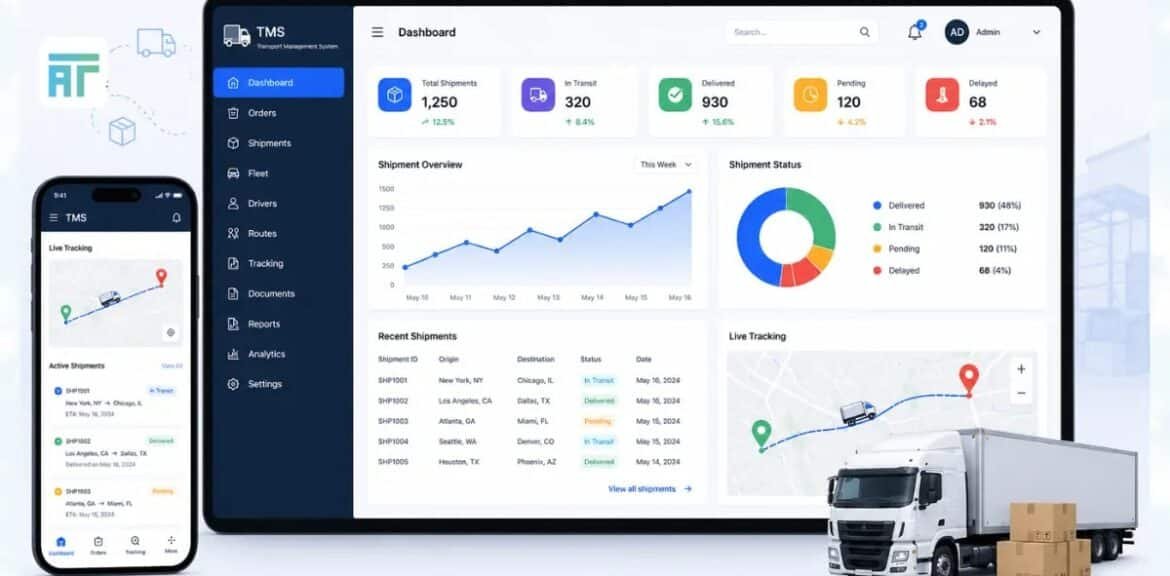

The transportation and logistics sector is undergoing a significant wave of digitization, with the primary aim of maximizing fleet efficiency, minimizing operational costs, and simplifying transportation operations. Besides logistics companies and fleet operators, providers of employee and school transportation services also automate vehicle tracking, route planning, dispatch management, and fleet monitoring using transport management software.
Companies that implement GPS tracking, route optimization, real-time fleet visibility, and automated transportation workflows want to know how much it would cost to outsource application development. The cost to develop transport management software ranges from $1,586.71 to $10,578+, depending on factors such as fleet size, features to be implemented, third-party integrations, deployment model, mobile applications, GPS tracking, and customization. Astha Technologies helps businesses with the decision-making process by identifying which factors to consider when designing efficient transport management systems aligned with their operations and future growth.
Why Transport Management Software Is Becoming Popular
The transportation and logistics sector is booming, and as a result, the need for efficient fleet and delivery management has increased significantly. Factors such as rising fuel prices, operational complexity, GPS-based vehicle tracking systems, and the desire for live updates are among the reasons companies are going digital. The government is also pushing the digital agenda and other smart transportation projects. Due to these developments, transport management software is being viewed as a must-have resource that can help logistics companies, fleet operators, employee transport providers, and public transportation organizations to get better control of their operations, improve efficiency, and save costs.
What Makes a Transport Management Software Successful?
A transport solution is only really useful if it addresses the challenges of daily operations instead of just digitizing the existing paperwork. Fleet managers require information about vehicle locations, trip progress, driver activities, maintenance schedules, and route performance without relying on spreadsheets or manual coordination. The best systems are not only user-friendly but also flexible enough to be adapted to changing business requirements, and they have features for handling business growth. Astha Technologies is at the forefront of developing software that mimics real-world transportation workflows, helping businesses enhance productivity, minimize operational problems, and better organize their operations.
Types of Transport Management Software
Every company has its own specific transportation needs. Therefore, it is necessary to find the software that best fits the organization’s specific operations. Astha Technologies, as a reliable mobile app development company in Gurgaon, not only offers tailored software that caters to the transportation-related needs of the business but also helps them in increasing capacity with minimum resources.
1. Vehicle Management Software
With vehicle management software, companies can keep track of their entire fleet, including vehicle registration, insurance, tracking fuel consumption, and availability of vehicles. All this will lead to the efficient use of vehicles and the smooth functioning of day-to-day transportation operations.
2. Route Management Software
Route management software is a powerful planning tool for businesses, helping them design optimal travel routes, minimize extra mileage, reduce fuel consumption, and improve delivery schedules. The vehicles hitting the target destinations can all be supported by this software.
3. Driver & Conductor Management Software
This software can easily handle driver and conductor information, attendance monitoring, license tracking, performance evaluations, and compliance record maintenance, thereby enabling effective workforce management.
4. GPS Tracking Software
Using GPS tracking software, you can track your vehicles in real-time. It allows you to see on a map, monitor the path, get regular location updates, and view driver behavior. Besides increasing the security of the fleet, it also helps in the escalation of operations and control efficiency.
5. Trip Management Software
The trip management software can take care of everything from planning a journey, assigning the vehicles & drivers, preparing schedules, and keeping an eye on the actual trip. With this tool, an organization can view trip status in real time, optimize vehicle and staff utilization, ensure smooth trip execution, and gather data for decision-making.
6. Transport Fee Management Software
Transport fee management software has become a necessity for many educational institutions, as well as companies that run employee transport, for automating processes such as fee collection, payment tracking, invoicing, and reminders. The software reduces the workload of administrative staff and also ensures that the financial records are transparent and accurate.
7. Maintenance Management Software
This maintenance management software can be really helpful to enterprises in many ways, such as planning fleet maintenance, tracking repairs, logging maintenance costs, and controlling spare parts inventory. Having a consistent maintenance schedule will minimize unexpected vehicle breakdowns and enhance the usable life of transport assets.
8. Employee Transport Management Software
If your company offers staff commuting services, then employee transport management software is essential for you. A powerful transport management system software covers all aspects of managing employee pickups, sub-routing, vehicle allocation, attendance monitoring, and enhancing the safety of commuters.
Key Features of Transport Management Software
One of the main reasons why a transportation platform becomes successful is due to its feature set. Enterprises require comprehensive vehicle, driver, route, trip, and expense management capabilities from a single software. The features listed next are not only vital for logistics but also for the public transport management software, boosting productivity, transparency, and informed decision-making.
Fleet Management
Fleet management is a system that allows companies to control every aspect of their vehicle operations, be it record keeping, deployment monitoring, or utilization analysis. Managing the fleet as a whole becomes easier while at the same time the throughput of the fleet and the level of activity are also enhanced.
Route Planning & Optimization
Route planning and optimization can be very useful for a business to determine the most efficient routes in terms of overall distance, traffic conditions, and timetables. Enhanced delivery capabilities, lowered fuel costs, and less travel time that is not productive are just some of the benefits.
GPS Tracking
GPS tracking offers on-the-spot access to the exact positions of vehicles along various routes and different locations. The use of this tool enables fleet management, geofencing, alerting, and an overall step-up in transportation safety and control.
Driver Management
Driver management enhances the administration of personnel by recording attendance, evaluating performance, and renewing licensing records. It supports organizations in strengthening accountability, facilitating compliance, and effectively managing transportation employees.
Fuel Management
Through fuel management, businesses can analyze fuel consumption and related transportation costs. With accurate information on fuel use, an enterprise can identify inefficient areas, control expenses, and improve fleet profitability.
Maintenance Scheduling
With maintenance scheduling, businesses can allocate time for the vehicle’s servicing, keep track of repair work, and get a reminder to do the maintenance on time. Periodic servicing helps reduce the risk of equipment failure, provides greater assurance for vehicles, and helps fleet assets last longer.
Trip Management
Managing trips entails digitizing the tasks of trip creation, delegation, scheduling, and tracking. Thus, trip management systems help business scalability, increase efficiency, and provide tighter control over transportation processes.
Reporting & Analytics
Reporting and analytics unveil hidden aspects of transportation operations at a granular level, such as cost scrutiny, route efficiency monitoring, and vehicle usage statistics. These revelations pave the way for excellent planning and the use of factual evidence for decision-making.
Mobile Applications
With the help of mobile applications, access is no longer limited as drivers, office staff, and passengers get connected through dedicated user interfaces. Alongside delivering better communication and simplified management, they also give the latest information to all the concerned parties.
Factors Affecting Transport Management Software Development Cost
Each transport company is unique, with its own operating requirements. That creates a challenge to fix a development budget with a firm figure. The final transport management software cost will be influenced by the complexity of the software, the features to be included, software integrations, whether you want it on-premise or in the cloud, and how you want to scale it in the future.
1. Software Complexity
The range and complexity of the software vary directly with project costs. A very simple software for vehicle management and driver records, together with basic reporting on operations, will not require much investment. But if you have complex transportation operations, then you may want features such as GPS tracking, route optimization, trip monitoring, analytics, and mobile applications. The majority of big companies require multi-location fleet management, integration of ERP, centralized dashboards, and AI-based route planning. All these extra requirements increase the developer effort, testing requirements, and overall cost of the project.
2. Number of Modules
The quantity of modules in the platform is one of the major things that impact software cost. A basic software for a transport management system may only cover vehicle records and driver management. But large transport companies may want additional features such as GPS tracking, route optimization, vehicle maintenance notifications, and a driver application system. With the inclusion of additional modules, the system becomes very detailed; thus, more development, testing, and integration work is necessary.
| Module | Estimated Additional Cost |
| GPS Tracking | $528 – $1,322 |
| Route Optimization | $634 – $1,586 |
| Driver Management | $423 – $1,058 |
| Maintenance Module | $528 – $1,322 |
| Mobile App | $1,058 – $2,644 |
3. GPS Device Integration
Most of the transport companies use GPS hardware for real-time vehicle tracking and fleet monitoring. Adding devices from companies such as Teltonika, Queclink, Ruptela, Jimi IoT, or even custom GPS APIs means doing more programming to handle location data, allowing geofencing, sending out different types of alerts, and supporting the regular exchange of information between the vehicles and the software platform. Therefore, the incorporation of GPS can greatly complicate the project. A trustworthy mobile app development company in Hyderabad will be able to provide app developers who can perform such integrations effectively without compromising the accuracy of tracking and overall system functioning.
4. Mobile Application Development
In the transportation sector, different user groups such as drivers, employees, transport managers, and even parents in school transportation systems often need separate mobile apps. Each app is designed for a specific function, and so it will need different user interfaces, different workflows, and also separate testing. Therefore, mobile app development can greatly add to the total project cost and duration. Collaborating with a seasoned mobile app development company in Delhi is beneficial as it can help the company develop easy-to-use and communicative apps that also allow real-time operational control.
5. UI/UX Design Complexity
Different transportation companies operate in different ways. For example, a small fleet company can easily function with a simple dashboard at its disposal, displaying trips, vehicles, and reports. On the other hand, larger players require at least two panels for dispatchers, fleet managers, drivers, and administrators, as well as live maps and operational insights. As the user interface becomes more individualized, the amount of design and development work increases. This is one of the factors that has a direct effect on the price of creating transport management system software.
6. Third-Party Integrations
Not many transportation companies operate their entire systems with a single software. It is quite common that vehicle locations come from GPS providers, routing information from Google Maps, payment methods through online gateways, and customer communication through SMS or WhatsApp services. Besides, a lot of companies also want their transport platform to be able to share data with their ERP software. Each integration comes with its own set of technical requirements, a new testing process, and maintenance considerations, which may result in increasing the development effort. Astha Technologies assists organizations in connecting these systems seamlessly while ensuring reliable data exchange across the entire transportation ecosystem.
7. Technology Stack Selection
Technology is one of the key decision factors that depend largely on the size and complexity of transportation operations.
| Area | Common Technologies |
| Frontend | React.js, Angular |
| Backend | Node.js, Laravel, .NET |
| Database | MySQL, PostgreSQL, MongoDB |
| Cloud Infrastructure | AWS, Microsoft Azure, Google Cloud |
| Mobile Applications | Flutter, React Native |
| APIs & Integrations | REST APIs, GraphQL |
| Security | SSL Encryption, OAuth, JWT Authentication |
| Reporting & Analytics | Power BI, Custom Dashboards |
8. Cloud vs On-Premise Deployment
The deployment model is a major factor in determining the long-term costs of development and operations. Cloud solutions are gaining popularity because they require a lower upfront infrastructure investment and provide businesses with the flexibility to scale up their transportation operations as they grow. This solution is really advantageous for organizations that expect vehicle volumes to go up, routes to expand, or user locations to multiply over time.
For an on-premises deployment, businesses have full control over their servers, data, and system environment. Although such a setup may be the choice for organizations with very strict security or operational requirements, it typically entails higher hardware, installation, and maintenance costs. Operators of public transport management software usually weigh these things carefully before choosing which deployment model would suit their needs the most.
9. Security & Compliance Requirements
With the increasing digitization of transportation operations, security should no longer be considered a last resort. Companies typically want to restrict access to vehicle records, trip details, financial information, and operational reports. Using role-based permissions, data encryption, audit trails, and automated backups can provide the necessary security; however, these are also features that need more planning and development. This is why, in many cases, security requirements end up influencing the price of making software for a transport management system.
10. Development Team and Location
It is uncommon that two vendors price a transportation software project identically. Some firms offer lower rates because they focus only on core development, while others include planning, testing, integration, and long-term support in their quotes. Businesses need to go past the cost per hour and check if the team has a deep knowledge of fleet management, GPS tracking, route planning, and the day-to-day problems transportation companies encounter. The capability of the team is likely to influence the quality of the output just as much as the price of development.
Transport Management Software Development Cost Breakdown
The cost to develop transport management software is generally spread over various stages, such as initial planning and designing, development, testing, and deployment. How much money you allocate for each stage also depends on how complex the project is, the features needed, the level of integration, and the extent of customization.
| Development Stage | Estimated Cost |
| Business Analysis & Planning | $265 – $793 |
| UI/UX Design | $423 – $1,058 |
| Frontend Development | $634 – $2,115 |
| Backend Development | $793 – $3,173 |
| GPS & API Integrations | $317 – $1,586 |
| Database Setup | $265 – $793 |
| Security Implementation | $317 – $1,058 |
| Testing & QA | $317 – $1,058 |
| Deployment | $158 – $529 |
| Total Cost | $1,586.71 – $10,578+ |
Cost Based on Software Scope
The overall transport management software cost will primarily depend on the extent of the software solution created. Small companies with straightforward requirements may only need a few functions, whereas extensive transport networks are likely to demand more sophisticated features, integrations, and automatic processes.
| Software Scope | Key Features | Estimated Cost | Timeline |
| Basic Transport Management Software | Vehicle management, driver management, reports | $1,586.71 – $3,173.42 | 1–2 Months |
| Standard Transport Management Software | GPS tracking, route management, and trip management | $3,173.42 – $5,289 | 2–4 Months |
| Advanced Transport Management Software | Mobile apps, analytics, maintenance management, and employee transport management | $5,289 – $8,462 | 4–6 Months |
| Enterprise Transport Management Software | Multi-branch management, ERP integration, AI route optimization, and advanced analytics | $8,462 – $10,578+ | 6–9+ Months |
Hidden Costs That Most Businesses Overlook
Several companies only consider the development cost while planning their projects and ignore other related expenses that they may have to bear throughout the life of the project. Such costs could impact the overall expense of owning the system over time. Astha Technologies, on the other hand, assists enterprises in discovering such expenses at an early stage and thus helps them to prepare budgets and plan the future of transportation software projects more effectively.
- GPS hardware: Buying, installation, and configuration of GPS equipment in the vehicles.
- Cloud hosting: Regular monthly or annual payments for hosting, storage, backups, and server resources.
- SMS & notification: The expenses of sending trip alerts, OTPs, route updates, and communication messages.
- Map API: Fees based on usage of Google Maps, route calculation, location tracking, and other services.
- Staff training: Learning the ropes will take time and resources from drivers, dispatchers, administrators, and other operational teams.
- Maintenance & support: Regular costs for upgrading the software, fixing bugs, improving performance, and providing technical support.
- Data migration: Transferring vehicle records, driver information, and historical transportation data from existing systems.
- Future feature upgrades: Extra money that will be needed to get new modules, integrations, or advanced functionalities as business needs grow.
Build vs Buy: Which Option Is Better?
Many transportation businesses eventually realize that spreadsheets and basic software are simply insufficient for them. Usually, at that point, the two main alternatives are buying existing software or developing one that will fit around the specific operational needs. Often, the right decision depends on aspects like fleet size, company growth plans, need for integration, and how much control over technology the business desires.
| Factor | Ready-Made Software | Custom Development |
| Initial Cost | Lower | Higher |
| Customization | Limited | Extensive |
| Scalability | Vendor-dependent | Fully scalable |
| Integrations | Restricted | Flexible |
| Ownership | Vendor-controlled | Complete ownership |
| Long-Term ROI | Moderate | High |
Essential Modules to Prioritize First
A lot of companies think that they should add all features at once. A gradual method, on the other hand, gives a chance to the transportation business to get benefits right away, and the development part does not get very expensive.
Phase 1: Core Operations
Initially, you need to build the basics, which will be your main tools to transport goods. Your work is to be done with the help of vehicle management, driver management, GPS tracking, and reporting to give you the visibility and control for efficient performance of your activities.
Phase 2: Operational Efficiency
After you have established a good base, you may consider adding route management, trip management, and maintenance modules. Doing so leads to reduced expenses and improved efficiency in fleets.
Phase 3: Advanced Capabilities
When the core processes are stable, it is possible to dedicate funds for analytics, mobile applications, and advanced integrations. Operating knowledge on a deeper level, a better user experience, and business scaling come with it.
How Long Does It Take to Develop Transport Management Software?
The length of development depends on how many features, integrations, user roles, and customizations are needed. Simple systems may be up and running in no time, but corporate platforms can take months of development and testing.
| Software Type | Timeline |
| Basic | 1–2 Months |
| Standard | 2–4 Months |
| Advanced | 4–6 Months |
| Enterprise | 6–9+ Months |
How to Reduce Transport Management Software Development Cost
The best way to keep the development cost under control is to emphasize the main features in the first phase rather than creating an all-inclusive platform at the very beginning. Initially, companies may start with fundamental modules such as vehicle management, driver management, GPS tracking, and reporting, and then integrate more complex features as their business requirements change. Additionally, using reliable third-party integrations, choosing scalable technologies, and avoiding over-customization can help keep the budget low without restricting future expansion. Collaborating with a well-versed mobile app development company in Noida can be a great idea, as businesses gain insights into making the right technology decisions and can avoid the high costs of redevelopment at a later stage.
Is Transport Management Software Worth the Investment?
Transportation companies usually get their money back and more by way of enhanced operational efficiency and cost savings when they invest in software. Optimizing the routes can lead to fuel savings. Tracking the fleet in real time leads to better utilization. Similarly, automated processes free up the drivers’ and the dispatch team’s productivity. One example is that even a 10-15% decrease in fuel usage across a large fleet can lead to remarkable annual savings. When combined with other benefits of bringing clients closer to the company, increasing operational insight, and reducing manual labor, transport management software can do all that while supporting the business’s future growth.
Why Choose Astha Technologies for Transport Management Software Development?
It is typical for transportation companies to face challenges such as different systems that do not communicate with each other, limited visibility, and manual processes that slow down overall operations. Astha Technologies understands these issues and adapts the software to the actual fleet operations. Be it GPS tracking, employee transportation, logistics management, or specially designed fleet workflows, we are a team of problem solvers who concentrate on delivering solutions that a user finds great, which a business can afford to implement at its different stages, and which come with long-term, reliable support even after the deployment.
Conclusion
Developing transport management software typically costs $1,586.71 to $10,578+, depending on factors such as desired functionality, complexity, third-party integrations, and deployment preferences. Many companies achieve better results by initially focusing on core modules and then increasing capacity as logistics problems evolve and become more complex. A perfectly designed, tailor-made system can improve fleet monitoring, streamline daily operations, reduce costs, and deliver a strong return on investment over time. Astha Technologies assists enterprises in developing efficient transportation systems that not only meet current requirements but also accommodate future expansion.
FAQs
What is transport management software?
Transport management software is a computer program that supports various aspects of transportation, including vehicles, drivers, routes, trips, and maintenance, all from a single platform efficiently.
Which is the best transport management software development company?
A company that provides the best services in the industry would have the combination of an understanding of the industry, the ability to develop a custom solution, provide a scalable solution, ease of integration, and availability of support services after launch.
How much does it cost to develop transport management software?
The cost of development generally ranges from $1,586.71 to $10,578+, depending on features, complexity, integrations, and deployment needs.
What are the main features of transport management software?
The most important functionalities are fleet management, GPS tracking, route optimization, driver management, creating trip schedules, reporting, and maintenance monitoring.
Who can use transport management software?
Besides logistics companies, it is common for transport management software to be used by fleet operators, schools, employee transport providers, courier businesses, and public transportation organizations.
Can transport management software track vehicles in real time?
Of course, the integration of GPS makes it possible to track the vehicle in real-time, monitor the route, use the geofencing feature, set up alerts, and, in general, have better operational visibility.
Is transport management software useful for logistics companies?
Definitely, among the things that transport management software assists logistics companies with are smarter route planning, cost saving, efficient fleet management, and delivery tracking.
Can transport management software manage school transport?
Certainly, transport management software can do a lot to manage school transportation, such as handling school buses, routes, transport fees, driver assignments, and real-time vehicle tracking.
How long does it take to develop transport management software?
Providing a precise duration for development depends heavily on requirements, but typically, simpler systems might take around 1-2 months, and very complex enterprise solutions might extend to 6-9+ months.
Can transport management software integrate with GPS devices?
Of course, it is capable of integrating with GPS devices and tracking platforms to deliver features such as location monitoring and route visibility.
Ready to Build a Custom AI-Powered App?


12M+
App Downloads
6 Months
Free App Maintance
20+
Industries Served
3 Months
Free Maintenance
×